Ink That Outlived Its Owner: The Impossible Task of Reading Someone's Private Pages
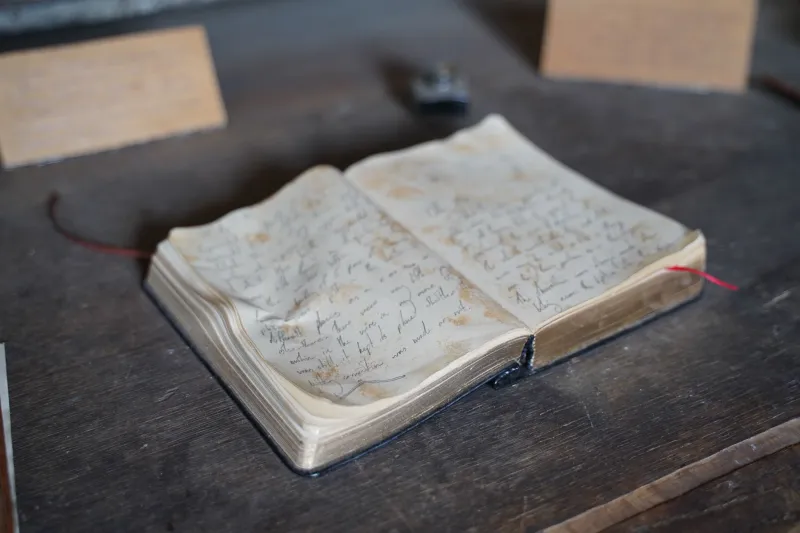
There's a particular kind of silence that fills a room when you open a journal that wasn't meant for you. Not the silence of an empty house, or the silence after bad news. It's something older and stranger — the silence of a person who can no longer tell you to put it down.
Every year, families across the country go through the belongings of people they've lost — to death, to disappearance, sometimes just to estrangement — and they find them. Spiral-bound notebooks shoved under mattresses. Leather-bound diaries wedged behind bookshelves. Composition books filled from margin to margin in handwriting so cramped and personal it looks less like language and more like a map of someone's nervous system. And the question that follows is never simple: Do you read it?
Most people do. And most people are never quite the same afterward.
The Literal Problem Nobody Talks About
Here's the thing that gets overlooked in every sentimental conversation about found journals: sometimes you genuinely cannot read them. Not because of grief, not because of guilt — but because the handwriting is just gone.
Faded ballpoint ink on yellowed paper. Pencil entries that have smeared into gray clouds. Cursive so idiosyncratic it looks like a foreign alphabet. Water damage that has turned whole paragraphs into soft, illegible bruises on the page. The physical decay of a journal can be just as devastating as any emotional revelation inside it.
Handwriting analysts and archivists who work with personal documents will tell you that most people develop their own private shorthand over years of journaling — abbreviations, symbols, half-words that meant something to the writer in the moment but translate to nothing for anyone reading decades later. A woman in her seventies might have spent fifty years writing in a script that was already going out of style when she learned it. A teenager in the nineties might have invented their own code to keep their diary safe from nosy siblings, and taken the key with them when they left.
Families have spent months — sometimes years — trying to reconstruct the inner lives of people they loved, one half-legible sentence at a time. There are entire online communities dedicated to this. People post photographs of difficult handwriting on forums and subreddits, asking strangers to help them decode a grandmother's entry from 1943, or a father's notes from the weeks before he disappeared. The desperation in those posts is palpable. Please, someone. Tell me what this says.
What We're Actually Looking For
The honest answer is that we're rarely just looking for information. We're looking for the person.
When someone dies suddenly, or vanishes, or simply drifts out of your life in ways that never got properly explained, there's an enormous amount of unfinished psychological business left behind. You had questions you never got to ask. You had a version of them in your head — a mother, a friend, a sibling — and you're not sure anymore how accurate that version was. The journal feels like it might hold the answer. Like if you can just get through the water-damaged pages and the cramped margins, you'll finally understand.
Sometimes people do find that. A daughter reads her late mother's diary and discovers a woman who was funnier, fiercer, and more uncertain than she ever let on. A husband finds his missing wife's notebook and realizes — with a particular kind of heartbreak — that she had been planning to leave for longer than he knew. A true crime researcher poring over a victim's journal finds a name that investigators missed, a detail that cracks something open.
But more often, what people find is partial. Incomplete. The journal covers three months and then stops. The most important entries are the ones that got torn out. The final pages are the most illegible of all, as if the handwriting itself was deteriorating in real time.
The Privacy Question That Has No Good Answer
Let's sit with the uncomfortable part for a second.
These journals were private. Deliberately, intentionally private. People who keep diaries are, by definition, writing for themselves — processing emotions they haven't shared, recording thoughts they haven't spoken out loud, working through versions of events that they chose not to broadcast. The act of keeping a journal is an act of self-preservation through privacy.
And when we read them after the person is gone, we are violating something. Even if the person is dead. Even if we loved them. Even if we desperately need to understand what happened. There's no way around the fact that we are reading words that were never meant for our eyes, and that the person who wrote them had reasons — good ones, probably — for keeping them close.
This is the tension that sits at the heart of every found journal story. The intimacy of the act is inseparable from the transgression of it. You are as close to this person as you have ever been, reading their private thoughts in their own hand. And you got here by crossing a line they drew.
Most people make peace with that. They tell themselves the person would have wanted them to know. They tell themselves understanding is a form of love. Maybe both of those things are true. But the guilt doesn't fully go away, and probably shouldn't.
The Entries That Change Everything
In true crime circles, personal journals hold a specific and complicated status. They've cracked cold cases. They've exonerated suspects. They've also, more than once, been misread — taken out of context, interpreted through the lens of what investigators already believed — and sent the wrong person to prison.
A journal entry written in the heat of anger doesn't mean what it seems to mean at face value. A person who writes I could kill him sometimes is almost certainly venting, not confessing. But once that sentence is read in a courtroom, the context evaporates and the words stand alone, stripped of everything the writer understood when they set them down.
This is part of what makes found journals so dangerous as artifacts. They were written without an audience in mind, which means they were written without the filters we apply when we know someone is watching. Every complicated feeling, every uncharitable thought, every moment of despair or rage or petty jealousy — it's all there, unedited, because the writer never imagined anyone else would see it.
Reading that is a gift and a burden at the same time.
What Gets Left in the Margins
Some of the most revealing things in old journals aren't in the entries at all. They're in the margins. A phone number written sideways. A name circled and then scratched out. A doodle that takes up half a page on what was apparently a slow afternoon. A grocery list wedged between two deeply personal confessions, as if the mundane and the profound were equally urgent on the same Tuesday afternoon.
Those details — the ones that were never meant to communicate anything — are sometimes the most humanizing. They remind you that the person who wrote these pages was also someone who needed to pick up milk. Someone who got bored. Someone who drew little stars in the corners when they were happy about something.
The journals we can no longer fully read are, in their own way, the most honest portraits we have of the people who left them behind. Incomplete, frustrating, occasionally indecipherable — but real in a way that polished memories never quite manage to be.
And maybe that's exactly why we keep trying to read them. Not because we'll find the answer, but because the trying itself is a way of staying close to someone who is already, in every other sense, gone.